
The effects of declining glacier cover on the biodiversity of invertebrates in alpine rivers

University of Leeds: Geography

Supervisors: Claudia Alvarado and Arthur Lamoliere

Contact: Arthur Lamoliere pjrw0504 @ leeds.ac.uk

Climate change is driving rapid glacier retreat worldwide, altering the physical and chemical conditions of glacier-fed rivers and leading to widespread changes in river ecology.

Macroinvertebrates, which include aquatic insects, worms and crustaceans, are key components of these ecosystems which contribute significantly to aquatic and terrestrial food webs and are integral in nutrient and carbon cycling, organic matter decomposition and the maintenance of high water quality (Milner et al., 2017). They closely interact with stream water and substrates, and as such they can be sensitive to changes in the stream environment that occur as glaciers retreat.

Research has shown that river habitats are becoming fragmented and some macroinvertebrate species are becoming range restricted as glaciers are lost, with notable impacts on community diversity and composition as well as ecosystem function (Milner et al. 2011; Brown & Milner, 2012; Jacobsen et al. 2012). Most notably, rare and cold‑adapted macroinvertebrates are increasingly being replaced by generalist species as environmental conditions shift. As specialist species disappear, shifts in community composition can trigger cascading impacts throughout the food web and disrupt key ecosystem functions by altering energy flows, nutrient cycling, and carbon dynamics, ultimately reducing the stability and functioning of glacier‑influenced ecosystems (Losapio et al., 2025).

In the European Alps, climate model projections indicate that around half of the region’s glaciers may disappear within the next two decades. Assessing the resulting impacts to freshwater biodiversity is therefore essential to inform conservation management and decision-making under accelerating climate warming. A recent study in the European Alps indicated that for the entire alpine zone, existing invertebrate datasets are only strong enough to make predictions about future biodiversity changes for 13 macroinvertebrate species (Wilkes et al., 2023). To put this into context, the rivers of the European Alps are home to hundreds of invertebrate species.

This project will investigate how freshwater invertebrates respond to glacier retreat in a glacier‑fed river system of the Hohe Tauern National Park in the Austrian Alps, with the aim of assessing biodiversity changes and the risk of local species losses linked to ongoing ice loss. The student will be supervised by PhD researchers and postdoctoral staff in the University of Leeds School of Geography, working closely with the River Basin Processes and Management Cluster and linking into the wider water@leeds network. During the placement, the student will develop their own focused project within the broader research framework. They will conduct a short literature review and design a research plan, carry out fieldwork and laboratory analyses, and present their findings to the research group.

The student will carry out an independent research project with close supervision and regular interaction with the research team.

Week 1 – Reading, Literature Review, Team Meetings
The student will conduct background reading on glacier‑fed river ecosystems, complete a short literature review, and meet the supervisory team to refine their project aims and research design.

Week 2 – Fieldwork
The student will participate in fieldwork, sampling Alpine glacier‑fed rivers (subject to logistics and approvals). Tasks will include collecting invertebrate samples, measuring environmental parameters using handheld electronic sensors, and assisting with site‑based data recording.

Week 3-4 – Laboratory Work and Basic Data Analysis
Working in the School of Geography laboratories, the student will process a subset of freshwater invertebrate samples and learn identification techniques. The student will receive training in preliminary data analysis including initial data entry and quality control of results, biodiversity metric calculation and basic statistical exploration of the results, with the opportunity to integrate new sample data with our existing datasets.

Weeks 5–6 – Write‑up and Presentation
The student will write a short project report summarising the methods, results, and their interpretation with reference to the literature. They will be invited to present their findings in student-led meetings and to the wider research group on completion of their placement.

The student will have weekly touch‑base meetings with their main supervisor. Both the student and supervisors will be present regularly in the office or laboratory, ensuring the student is fully supported and never working without guidance. They will integrate with ongoing research in the River Basin Processes and Management Cluster and interact with other School of Geography PhD students, postdocs and technical staff throughout.

By the end of the placement, the student will have developed skills in:

  • literature review and research design
  • field sampling (or lab‑focused methods if contingency plan activated)
  • freshwater invertebrate identification and sample processing
  • data management and applied statistical analysis
  • scientific writing and oral presentation

Contingency Plan

If fieldwork is not possible due to logistical or administrative constraints, the project will move to a laboratory-based exercise, with expanded sample processing and data analysis to ensure a complete research experience. This will draw on a bank of our existing samples that are awaiting laboratory processing.

Claudia Alvarado — PhD Researcher
Claudia will co‑supervise the student, supporting project planning, field and laboratory methods, and day‑to‑day guidance. She also brings valuable insight as a former NERC REP student (Central England NERC Training Alliance at University of Birmingham), helping ensure an inclusive and supportive research experience.

Arthur Lamoliere — PhD Researcher
Arthur will co‑supervise alongside Claudia, contributing to project design, method development, analytical support and day‑to‑day support. He provides specific expertise on alpine river species modelling and the study region through his ongoing PhD research.

Prof. Lee Brown — Professor of Aquatic Science
Prof. Brown will offer overarching academic oversight and ensure scientific quality. He will provide expert input on glacier‑fed river ecology and help integrate the student into the wider research group.

The proposed Research Experience Placement will develop the student’s understanding of global change, hydrology, invertebrate ecology and environmental policy as interlinking areas of environmental research. The student will gain an interdisciplinary approach to research, which is a valuable skill sought by employers. The student will be trained on the techniques necessary to practically apply their theoretical knowledge with confidence. They will gain experience with: (i) field-based health and safety, logistics, river surveyance, water sampling and benthic macroinvertebrate collection; (ii) laboratory-based microscopy and morphological identification; and (iii) data processing and statistics, including the calculation of macroinvertebrate diversity indices commonly used for biomonitoring. The practical experience gained from this placement will be transferrable to multiple settings, from UK-based river ecology research to the study of other rivers globally. Should the student wish to pursue European or alpine research after this placement, they will also benefit from learning about regional taxa and from building a desirable international fieldwork portfolio. The student will write up their results in a publication-style research paper, gaining experience in academic writing beyond the expectation of an undergraduate degree. They will additionally prepare their research for presentation at a department cluster meeting and for wider communication in the final week(s) of their placement, and in doing so will develop an appreciation of how science is translated to different audiences – including academic audiences in different fields. The student will benefit from working within the School of Geography, where they will work alongside current postgraduates and expert researchers in the fields of river ecology and glaciology. Foremost, the student will be able to use this resource to learn about the expectations and requirements of a career in research, including administrative aspects and application processes for postgraduate study. Beyond this, the student will have the opportunity to proactively begin building their own research network. This proximity advantage is not available to most prospective researchers and will thus be of great benefit to the student’s future study applications and research proposals. Beyond the remit of their placement, the student will also benefit from participation in student-led ‘ICE club’ meetings and socials, which will enhance their experience of research culture. Through the above the student will develop a suite of additional skills, including project and time management across the prescribed six-week placement period, team working within a research organisation and a sense of individual ownership towards a larger research aim.

Quantifying uncertainty in carbon cycle modelling

University of Exeter: Maths & Statistics

Supervisor: James Salter j.m.salter @ exeter.ac.uk

Understanding how much carbon is absorbed by land ecosystems is essential for predicting future climate change and estimating the remaining carbon budget for limiting global warming. Scientists use computer models to simulate how forests, soils, and vegetation exchange carbon with the atmosphere. These models play an important role in climate research but contain many uncertain parameters that influence their predictions.

This project sits at the interface of climate science, statistics and machine learning (ML), and will contribute to ongoing research aimed at improving estimates of the global carbon cycle and carbon budgets. The project will use statistical and ML techniques to investigate how uncertainty in model parameters in the land surface model (JULES) affects predictions of carbon uptake.

The project will focus on using stats/ML tools to analyse a pre-prepared set of JULES simulations, to explore how different parameter choices affect the model’s representation of the real-world. Within this, there are many interesting questions, and the exact objective of the project is flexible, allowing the student to focus on a particular scientific question (for example, site-scale carbon fluxes or future climate scenarios) or on methodological aspects of model emulation and calibration. Through this work, the student will gain experience applying statistical and ML methods to real-world environmental modelling problems.

The student will be embedded within an active research group working on the global carbon cycle and climate modelling. They will have the opportunity to attend group meetings and interact with researchers working on climate science, environmental modelling, and statistics. The project contributes to ongoing research programmes at the University of Exeter and the Met Office, and the student will gain insight into how environmental models are developed and used in climate assessments. There will also be opportunities to engage with wider academic networks (e.g. statistics and environmental modelling groups) and to present their work in an informal research setting at the end of the placement. This project would be particularly suitable for students interested in pursuing postgraduate research combining statistics or machine learning with environmental or climate science.

Quantifying uncertainties in glacial lake water storage to inform cryosphere and natural hazards research

University of Leeds: Geography

Supervisor: Scott Watson c.s.watson @ leeds.ac.uk

As glaciers disappear, many are leaving behind glacial lakes, which can span several kilometres in length and reach depths of hundreds of metres. These lakes act as a positive feedback mechanism, accelerating glacier mass loss. In some cases, they can also pose a downstream flood risk in the event of a glacial lake outburst flood (GLOFs). This hazard is particularly pronounced in High Mountain Asia, including countries like Nepal, where the exposure and vulnerability of people and infrastructure to GLOFs is high. Therefore, there is a requirement to closely monitor changes at glacial lakes using satellite data, owing to their remote and high-altitude locations.

The researcher will use Surface Water Ocean Topography (SWOT) data to analyse changes in the water surface elevation of glacial lakes in Nepal. This data, generated by the Ka-band Radar Interferometer (KaRIn), provides water elevation measurements at approximately 20-meter spacing. The researcher will build on our existing scripts to analyse the spatial and temporal changes in lake water levels across Nepal. The dataset will reveal novel insights into water storage and will contribute to the Glacial Lake Observatory project. The researcher will also explore comparisons with other datasets such as ICESat-2 altimetry and our field-derived Global Navigation Satellite System observations. The researcher will have the opportunity to discuss their work at Glacial Lake Observatory team meetings and will be trained to access and analyse the data, and present their findings.

The candidate should be familiar with a GIS package (e.g. QGIS or ArcGIS) and have an interest in satellite data. Some coding experience (e.g. R or Python) would be beneficial but is not required. Full training in the methods required to complete the project will be provided.
The researcher will access SWOT data over glacial lake catchment where we have field observations of lake bathymetry and water level elevations. Data will be filtered using geolocation quality and classification flags. Water surface elevations will be computed by subtracting tidal loading corrections and referencing the heights to the EGM2008 geoid. These results will be integrated with field-measured bathymetry and compared with GNSS water level observations to derive glacial lake water storage, associated uncertainties, and seasonal changes. The methodology will be scripted in R or Python to support reproducibility and produce semi-automated time series analysis of water level changes at priority glacial lakes.

Through regular supervision and research group meetings, the researcher will be supported to write up their methodology into a reproducible script and short report with high-quality figures to summarise their findings. The research will disseminate their findings through Glacial Lake Observatory social media channels and our upcoming website.
The researcher will work within the broader Glacial Lake Observatory team and will be supported to present their findings to one of our school research cluster meetings.

Data science to help reduce uncertainty in climate models

University of Leeds: Earth, Environment & Sustainability

Supervisor: Léa Prévost eelp @ leeds.ac.uk

Aerosols play a major role in climate, but they remain one of the largest sources of uncertainty in climate models. One way we study this uncertainty is through a perturbed parameter ensemble (PPE), where we run the same model many times with different values for uncertain aerosol processes such as emissions, chemistry and deposition. Doing so creates a range of plausible atmospheres and helps us identify which processes drive model uncertainty and how well the model matches real world observations.

Until now, our research has focused on monthly averages, which smooth out the day to day variability of aerosols. Daily data can look very different because aerosols are short lived and influenced by weather. In this project, you will analyse the daily dataset from a new PPE, giving our first detailed view of day to day variability. You will assess how much conditions change from one day to the next, how well the model captures daily observations, and whether the key uncertain processes differ at finer timescales. You will also test whether grouping days into categories such as wet and dry, or high and low aerosol days, reveals patterns hidden by monthly averages.

A student who enjoys data analysis and problem-solving will be a great fit. You will gain hands on experience with climate data, present your results to our research group and an external team, and have the opportunity to attend the UKCA Science Meeting to hear about current modelling priorities and ongoing challenges in the model you will be working with.

The project will follow a structured six week plan:

  • Week 1: Set up on the HPC, get familiar with the ensemble, and explore daily vs monthly behaviour.
  • Week 2: Bring in daily observations and compare model–observation distributions.
  • Week 3: Run daily scale sensitivity analyses to see whether the dominant uncertain parameters change from day to day.
  • Weeks 4–5: Test alternative ways of grouping the daily data, for example by meteorological conditions (such as wet versus dry days) or by aerosol state (such as high AOD versus low AOD days) and examine how model biases and parameter sensitivities differ between these groups.
  • Week 6: Summarise what daily data reveals that monthly averages hide and clearly demonstrate how daily variability and grouped day analysis change our understanding of the PPE compared to the existing monthly mean perspective.

Interactions: The supervisor will check in with the student daily to discuss goals and progress, provide feedback on figures and interpretation, and guide next steps. The student will also have opportunities to present emerging results to the research group and receive supportive, constructive input from the wider team.

Skills gained: The student will gain an understanding of how climate models work and where uncertainty comes from, develop familiarity with aerosol processes and how parameter choices influence model output, and build experience handling large datasets on an HPC. They will also strengthen their data analysis and coding skills and learn to communicate their findings clearly to an audience of researchers.
The student will be fully embedded in an active research environment.

They will:

– Participate in weekly Aerosol, Clouds & Climate group meetings, a vibrant research group that runs skill building sessions (for example on designing posters or making the most of conferences) as well as regular science talks from researchers at a range of career stages.

– Join our smaller PPE subgroup to hear about current PPE research and the open questions/challenges about modelling uncertainty.

– Present their results to the external project “Towards maximum feasible reduction in aerosol radiative forcing”, a collaboration with the University of Sheffield. The project uses the same PPE tools to investigate how aerosol uncertainty influences radiative forcing, and the insights from daily scale analysis will provide an important contribution that is expected to attract strong interest from the team.

– Attend the UKCA Science Meeting, where they’ll hear about current modelling priorities and challenges specific to the model they’ll be working with.

Analysis of ice-nucleating particles influencing the UK using FLEXPART back-trajectory analysis

University of Leeds: Earth, Environment & Sustainability

Supervisor: Ross Herbert R.J.Herbert @ leeds.ac.uk

Ice-nucleating particles (INPs) are a rare subset of aerosol particles that facilitate ice formation in sub-zero clouds. Their role in the climate system remains uncertain, part of which is because we still lack a full understanding of their abundances and sources across the globe.
Recently, measurements of INPs were made during a 6-month campaign at the Weybourne measurement site on the east coast of the UK. The measurements show us that the number of INPs varied depending on the wind direction. We hypothesize that the wind direction is associated with different airmasses, each of which contains different aerosol particles and INPs transported from different regions. A key part of the puzzle is establishing exactly where that air came from and help link possible aerosol and INP sources to the measurement site.

Using back-trajectory analysis with the FLEXPART model, we can pick a location at a specific time and track where the air and associated aerosols came from in the previous days to weeks. This can give us a picture of where the air most likely originated from, and what altitudes it was transported at. Linking the back-trajectory analysis to specific days in the campaign period will show us where the air came from, helping us to test our hypothesis.

Additional information measured at the Weybourne site can help us build up a complete picture of what aerosol species were acting as INPs; this includes aerosol size distributions, chemistry data, and rainfall. We can make use of satellite datasets and climate model output that we have in the research group to estimate what aerosols and INPs were being transported in the different airmasses, and whether rainfall played a role during its transport in the atmosphere.

The outcomes of this placement will provide key information alongside the INP measurements and are likely to help support a future publication of the campaign.

Ross Herbert and Eszter Kovacs will be the primary points of contact for student during the placement. Martin Daily led the measurement campaign and will provide assistance accessing and using the data collected. Professors Ben Murray and Ken Carslaw will provide additional support.

1. Learn how to set up and run the FLEXPART model on the University of Leeds’ high-performance computer AIRE and analyse the output using python (Eszter Kovacs to help).

2. Run the FLEXPART back-trajectory model and analyse the output to identify sources of airmasses influencing the Weybourne measurement site on key days during the campaign that displayed contrasting conditions.

3. Identify links between the sources of airmasses and the number of ice-nucleating particles (INPs) measured at the site.

4. If time allows, the student will compare meteorological data and aerosol size distributions from MetOffice UK Earth System Model (UKESM) simulations and satellite observations (both provided by Ross Herbert) to those measured at the site.

5. Attend a 2-day hackathon and conference focusing on aerosol and chemistry being held in Leeds (July 16-17).

6. Present results to the research group at the end of the placement.

At the end of this placement the student will gain the following skills:

Using the command line; using a supercomputer; setting up and running a complex model; analysing and visualizing data in python; using output from a global climate model; using satellite observations; hypothesis testing; presentation experience; and a deeper understanding of aerosol science and the climate.
The student will attend and take part in weekly meetings with the Ice Nucleation group and the Aerosols, Clouds, and Climate group. The student will be given a tour of the laboratories to better understand how we measure aerosols and spend time shadowing one of the researchers in the Ice Nucleation group (Jack Macklin) making INP measurements in the laboratory. Ross Herbert is co-leading a 2-day hackathon and workshop focusing on aerosols and chemistry in the UKESM that takes place on July 16-17 within the University. If the timing is appropriate the student will be invited to join us, with the possibility of producing a research poster for the event.

Research Experience Placements 2026

We are now accepting applications for NERC Research Experience Placements (REPs) for the summer of 2026!

Paid 6 week Summer Projects for Undergraduate/Integrated Masters students

We are pleased to announce that the Natural Environment Research Council (NERC) have awarded UNRISK funding for 4 Research Experience Placements (REPs) at the University of Leeds and Exeter to be completed over the 2026 summer period.

The NERC REP scheme aims to encourage students to consider a career in environmental sciences through funding to support paid summer placements for undergraduate and Masters students, by giving them a taster of what it’s like to be a postgraduate researcher.

The scheme provides 4 paid research placements over the Summer (June/July/August).

You will be made an employee at the University of Leeds and receive a salary at Grade 2 level (above national living wage) for the duration of the placement, plus payment for 1 weeks annual leave.

We particularly encourage students from underrepresented groups to apply and priority will be given to these applicants (ethnic minorities, those with a disability or from low-socio-economic backgrounds).

Applications are open to students from all universities, and all subject disciplines.  You can apply to more than one NERC REP project – just submit one application form for each project.

Placement Details, Funding and Reporting

  • Placement duration is 6 weeks full time (plus a further week of paid annual leave) during the summer vacation period (June/July/August).  The time can be a continuous block, or split to accommodate prior commitments.
  • Placements (at Leeds) are paid at University of Leeds’ Grade 2 level (Spine Point 11).
  • There is no additional funding available for relocation or accommodation.
  • REPs do not meet the requirements for a visa request, and therefore, are only open to UK citizens or those who already have a right to work or study in the UK .

Applicant Eligibility

Applicants must:

  • Be undertaking their first undergraduate degree studies or integrated Masters.
    • Note: students in their final year who will have graduated and no longer have student status at the time the placement starts are not eligible. If you still have student status at the beginning of the placement, we will consider the eligibility criteria to be met, even if you graduate during the course of the placement.
  • Be eligible for subsequent NERC PhD funding (Details of eligibility for PhD studentships can be found here. Please note this guidance should be read in conjunction with the UKRI Training Grant Terms and Conditions and guidance documents available here).
  • Have the right to work or study in the UK or have home-fees status. REPs do not meet the requirements for a visa request.

Research Projects

REP projects will:

  • Have a clearly defined objective.
  • Be within the science remit of NERC
  • Be feasible for a student to complete within the timescale of the award (~6 weeks).
  • Include more than purely a computer/modelling component i.e. some element of fieldwork, data collection, activity to give an understanding of the wider context including participation in lab/team meetings, networking and training etc.
  • Give scope for thought and initiative on the part of the student and should not use the student as a general assistant.
  • Be based at one of the UNRISK partner institutions (i.e Leeds or Exeter). NB: remote placements are also an option for enabling inclusivity.
  • Will meet demographic and diversity-related challenges.
  • Will meet the quantitative skills gap in environmental sciences.

How to Apply

  1. Select the project of most interest to you
  2. Complete the online REPS Application form

Application deadline: 30th April 2026

Available projects for 2026:

Quantifying uncertainties in glacial lake water storage to inform cryosphere and natural hazards research

The effects of declining glacier cover on the biodiversity of invertebrates in alpine rivers

Data science to help reduce uncertainty in climate models

Analysis of ice-nucleating particles influencing the UK using FLEXPART back-trajectory analysis

Quantifying uncertainty in carbon cycle modelling

UNRISK Schools Outreach Activity

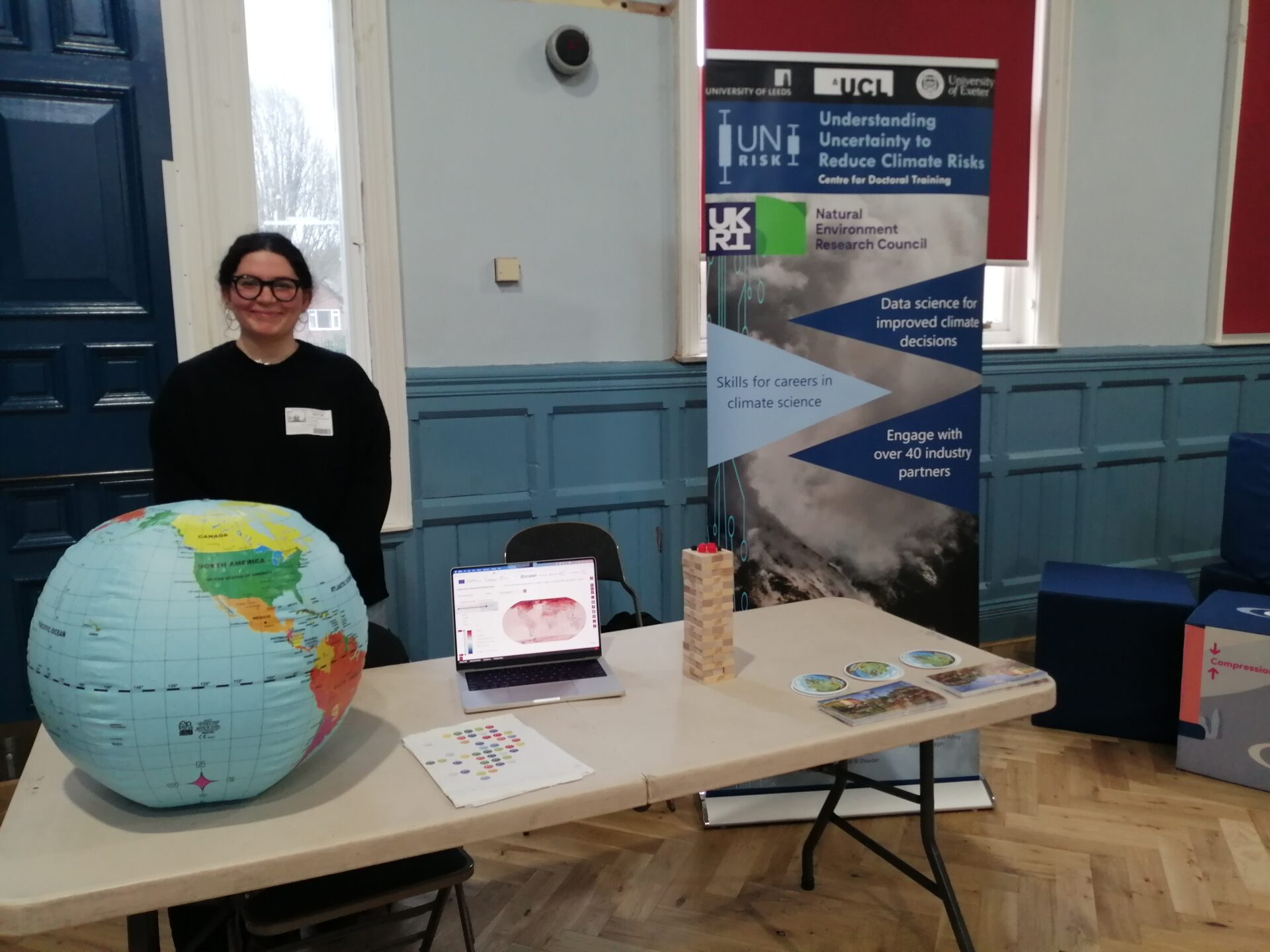
UNRISK student Celine Tchaghlassian at Chapel Allerton Primary School, Leeds

PhD Student at School Outreach event

UNRISK PhD student Celine and James Mckay, UNRISK CDT manager, visited Chapel Allerton Primary School in Leeds for their annual Science Careers Fair, 12 March 2026. The idea is that the children find out about careers in science from various organisations including civil engineers, dentists, pharmaceutical companies, veterinary practices, and University researchers.

James has taken part in this event for several years, liaising with the school to enable CDT students to get a taste of going into schools to do outreach. The school children have also taken part in a Royal Academy of Engineering-funded project led by James educating children about the transition to a zero carbon future.

On the day, each group of 3-4 children spend about five minutes at each stall. On the UNRISK stall the children learned about climate change risks – where are the biggest risks to people? (they had to place a sticker on our inflatable globe). Celine showed them how to do a bit of coding to change map visualisations, and then they played a ‘Jenga’ game, with a group of houses sitting on top, representing a coastal scenario where cliffs are being undermined by sea level rise and more frequent storms. The children had to remove the Jenga blocks and estimate the risks of the houses collapsing – understanding about how climate risks are communicated.